Losing a few teeth, whether from decay, gum disease, or an injury, does not always call for a full denture or a mouth full of implants. Partial dentures fill in the gaps left by missing teeth while keeping your remaining healthy teeth exactly where they are, restoring your bite and your smile without more treatment than you actually need.
Dr. Mascarenas and the team at Sonoran Dental Studio design partial dentures for patients throughout Buckeye who are missing one or more teeth but still have a strong foundation of healthy teeth remaining, offering a practical alternative to full dentures for patients who do not need to replace an entire arch. A well-fitted partial denture can restore chewing function, prevent your remaining teeth from shifting, and give you back a complete smile in a matter of weeks rather than months.
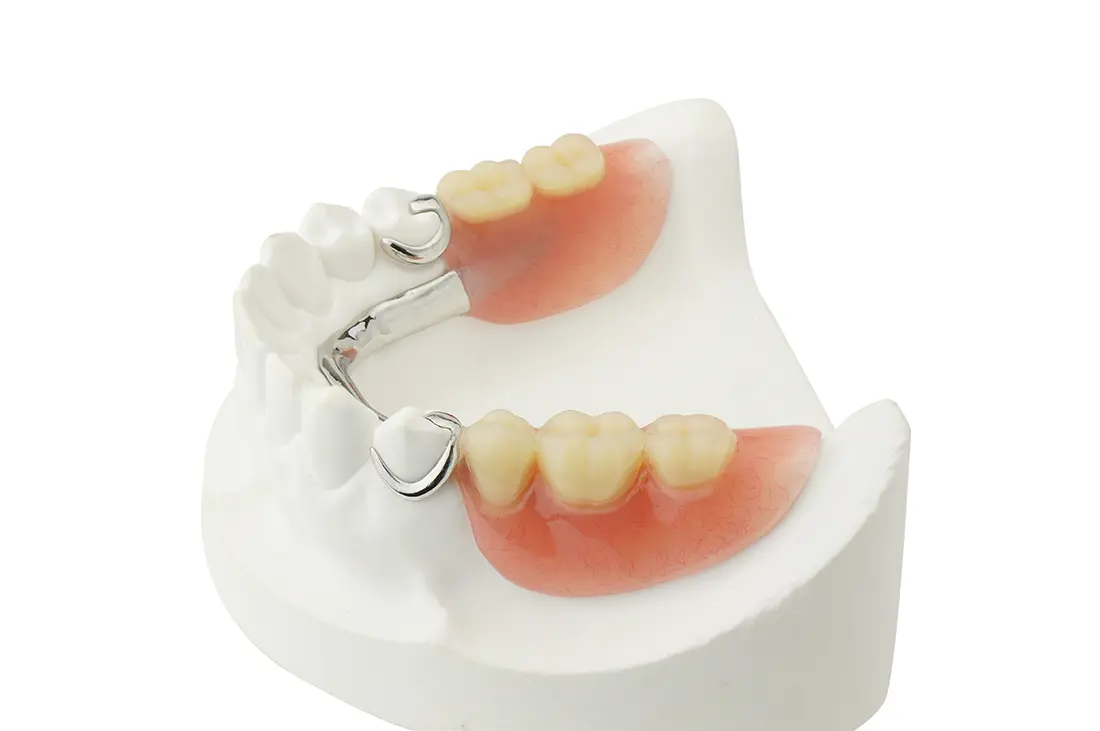
A partial denture is a removable appliance that replaces one or more missing teeth using a combination of artificial teeth set into a gum-colored base, held in place by metal or flexible clasps that grip onto your remaining natural teeth. Unlike a full denture, which replaces an entire arch, a partial denture is designed specifically around the teeth you still have, filling only the gaps where teeth are missing.
Partial dentures come in a few different styles, including cast metal frameworks known for their durability and flexible resin-based options that some patients find more comfortable against the gums. The right style depends on how many teeth are missing, where the gaps are located, and how much support your remaining teeth can provide, which is why we always start with a full exam and impressions before recommending a specific design.
Most patients who are missing one or more teeth but still have several healthy, stable teeth remaining are good candidates for a partial denture. This makes partial dentures a strong fit for patients who are not ready or not able to pursue implant treatment, whether due to bone loss, budget, or simply a preference for a removable, non-surgical option.
Healthy gum tissue and reasonably stable remaining teeth help a partial denture fit and function well over time, so we check for any active decay or gum disease before moving forward with treatment. If teeth need to be removed before the partial is fitted, our tooth extractions in Buckeye can prepare your mouth for a smooth transition. If several teeth are missing across an arch, or if the remaining teeth are too weak to support a partial comfortably, we will talk through other paths, including dental implants, so you understand every option available before deciding what is right for you.
A dental bridge is often the first alternative patients consider, since it also fills a gap left by missing teeth, but a bridge is permanently cemented in place and requires reshaping the healthy teeth on either side of the gap to support it. A partial denture avoids altering those teeth at all, since it simply clasps onto them and can be removed for cleaning, which makes it a more conservative option for patients who want to preserve as much natural tooth structure as possible.
Implants replace missing teeth at the root level and do not rely on neighboring teeth for support, which generally makes them the more stable, longer-lasting option when a patient is a good candidate. That said, implants involve a surgical placement and a longer overall timeline, while a partial denture can typically be designed and delivered in a matter of weeks. For patients missing several teeth or an entire arch who are considering a fixed alternative, our dental bridges page covers that option in more detail alongside the implant path discussed above.
Getting a partial denture starts with an exam, impressions, and a bite evaluation to design a framework that fits your mouth precisely and distributes bite force evenly across your remaining teeth. Once the appliance is fabricated, Dr. Mascarenas checks the fit, adjusts the clasps as needed, and walks you through how to insert, remove, and clean it properly so it lasts as long as possible.
Most patients adjust to wearing a partial denture within the first few weeks, though some initial soreness or minor speech changes are normal while your mouth adapts to the new appliance. A systematic review of patient-reported outcomes published through the National Institutes of Health found that removable partial denture wearers generally report high satisfaction, with reported rates ranging between 50 and 81 percent, and that satisfaction tends to increase with age and consistent use. Daily removal for cleaning, along with regular checkups to monitor the fit as your gums and jawbone change over time, helps keep a partial denture comfortable and functional for years.
Dr. Mascarenas takes a concierge-style, patient-first approach to every restorative case, which means your partial denture is designed around your specific bite, remaining teeth, and daily habits rather than a generic mold. You will always receive a clear explanation of your options and realistic expectations for fit, function, and adjustment time before treatment begins.
We also make partial denture treatment accessible for patients without dental insurance through our in-house membership plan, along with financing options through Cherry and CareCredit for patients who want to spread the cost of treatment out over time. If missing teeth have been affecting your bite or your confidence, contact our office to schedule a consultation and find out whether a partial denture is the right fit for your smile.
The first modern dental implant was installed into a patient’s jaw in 1965.
See real patient success stories.
Clear Aligner Therapy
See real patient success stories.